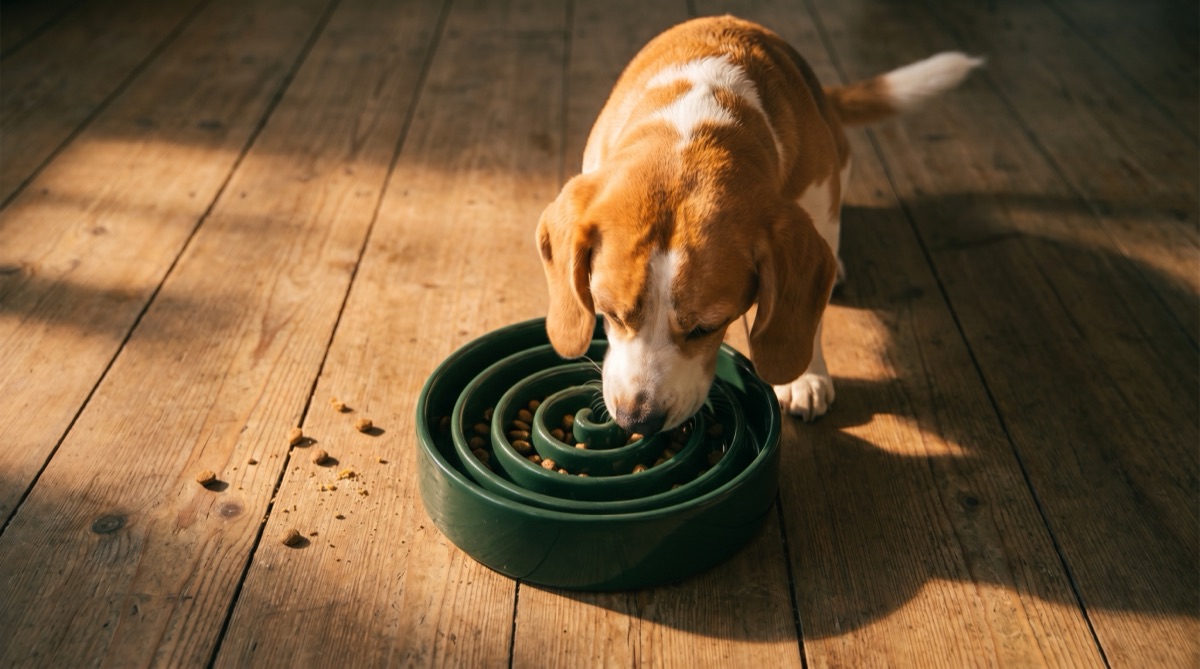
If your dog finishes dinner before you finish setting down the bowl, you already know the scene. Thirty seconds of frantic clanking, a burp, and a look that says "was that it?" It is funny right up until it is not, because eating that fast is uncomfortable for your dog and, for some dogs, genuinely risky.
So, do slow feeder bowls work? Short version: yes. For dogs that gulp their food, a slow feeder reliably stretches a seconds-long inhale into an actual meal. Here is how they do it, who really needs one, and how to pick a pattern your dog will work with instead of rage-flipping across the kitchen.
The short answer: yes, for gulpers
A slow feeder is not complicated technology. It is a bowl with ridges, spirals, or maze walls molded into the bottom. Instead of scooping up huge mouthfuls, your dog has to chase kibble through the channels with their tongue and pick up a few pieces at a time. The slowdown is mechanical and immediate: the food is physically harder to grab, so the meal takes longer. A dinner that vanished in under a minute typically becomes several minutes of nose-down work, depending on the pattern and how determined your dog is.
That is the whole trick, and it is exactly why slow feeders work on day one with no training. Your dog does not have to learn anything. The bowl simply will not let them gulp.
Two honest caveats. First, a slow feeder changes pace, not appetite. A food-obsessed Lab will still be food-obsessed, just slower about it. Second, a slow feeder is a feeding tool, not a medical device. If your dog's eating habits changed suddenly, or fast eating comes with vomiting, weight loss, or other symptoms, that is a vet conversation first and a bowl purchase second.
Signs your dog eats too fast
"Too fast" is easier to spot than to define, but these are the classic tells:
- The meal is gone in under a minute. Most gulpers finish in 15 to 30 seconds. There is no chewing happening at that speed.
- Coughing, gagging, or choking sounds mid-meal. Kibble going down whole and fast can catch on the way.
- Regurgitating food shortly after eating. A classic gulper move: the meal comes back up nearly intact, and some dogs immediately try to re-eat it.
- Loud burping and a visibly tight belly after meals. Gulping food means gulping air along with it.
- Frantic energy around the bowl. Pacing, whining, body-blocking other pets. Speed and stress at mealtime often travel together, especially in multi-dog homes.
If a couple of those sound like your kitchen, you have a gulper, and a slow feeder is one of the cheapest quality-of-life upgrades you can make.
Why slower is better
The everyday case for slowing down is comfort. A dog that chews instead of inhaling swallows less air, which means less burping, less of that post-dinner balloon belly, and fewer episodes of food making a return trip. Mealtime also gets calmer. Working through a maze gives an intense eater a job to do, and ten minutes of focused snuffling beats thirty seconds of frenzy for just about every dog.
Then there is the bigger conversation: bloat. Gastric dilatation-volvulus, or GDV, is a life-threatening emergency where the stomach fills with gas and can twist on itself. It is most common in large, deep-chested breeds. A study published in the Journal of the American Veterinary Medical Association in 2000, led by researchers at Purdue University, followed more than 1,600 large and giant breed dogs, including Great Danes, Weimaraners, Saint Bernards, Irish Setters, and Standard Poodles. It found that a faster speed of eating was among the factors associated with an increased risk of GDV, alongside increasing age and having a close relative with a history of the condition.
We want to be straight with you about the limits of that science, because plenty of product pages are not. A later review in the journal Veterinary Evidence looked specifically at whether fast-eating dogs are more likely to develop GDV and concluded the evidence is limited and not ironclad. Eating speed is one suspected risk factor among many, not a single cause, and no bowl can prevent bloat. What we can say honestly: slowing a gulper down is the kind of low-cost, low-risk change that veterinary guidance generally supports, and it makes dogs more comfortable regardless. If you have a large, deep-chested breed, talk to your vet about GDV risk specifically. Know the warning signs (unproductive retching, a swollen or hard belly, restlessness, drooling) and treat them as an emergency, every time.
Picking a pattern
Slow feeders mostly differ in two ways: how hard the maze is, and how the shape fits your dog's face. Both matter more than color.
Maze difficulty vs frustration
Difficulty is a dial, not a virtue. The goal is a dog that eats slower and stays interested, not a dog that gives up or flips the bowl like a tiny table at a bad restaurant. A few rules of thumb:
- Start moderate. Wide spiral or ridge patterns slow most dogs plenty. Save the tight, deep labyrinths for confirmed speed demons who breeze through level one.
- Watch the first few meals. A little puzzling is good. Pawing, whining, walking away, or grabbing the bowl edge means the pattern is too hard. Step down a level.
- Match the channels to the muzzle. A big dog with a broad snout needs wider channels than a Chihuahua. If your dog physically cannot reach the food, that is not enrichment, that is a vending machine that ate their quarter.
- Weight and grip matter. Determined eaters will shove a light bowl across the floor or flip it to dump the kibble. Look for a non-slip base and some heft. Our own Slow and Steady feeder in the Bowls & Feeding collection is built around exactly that fix.
Flat-faced breeds need shallow patterns
Brachycephalic dogs, the short-muzzled crew like French Bulldogs, Pugs, Boston Terriers, Bulldogs, and Shih Tzus, deserve their own paragraph. A short muzzle simply cannot reach the bottom of deep, narrow channels, and many flat-faced dogs already work harder to breathe while they eat. For these dogs, pick a shallow, wide-spaced pattern, more speed bump than labyrinth. Plate-style slow feeders with low ridges are often the sweet spot. The same shallow-pattern advice applies to senior dogs with neck or joint stiffness and to very small breeds whose whole face fits inside one maze channel.
Slow feeder vs puzzle feeder: different jobs
These two get lumped together, but they solve different problems. A slow feeder is mealtime infrastructure: it goes down at breakfast and dinner, every day, and its job is pace. A puzzle feeder or treat-dispensing toy is enrichment: its job is to make your dog think, sniff, and problem-solve, usually with part of a meal or some treats, and usually not every single feeding.
A good way to decide: if the problem is "my dog inhales dinner," start with a slow feeder. If the problem is "my dog is bored, restless, or destroying the couch out of under-stimulation," you want a puzzle toy or snuffle mat from our Toys & Fetch collection, where the Busy Brain puzzle lives. Lots of dogs benefit from both, and they stack nicely: slow feeder for meals, puzzle for the long Tuesday afternoon. And if mealtime frenzy comes with bigger behavior struggles like resource guarding or general anxiety, some structured work with tools from our Training & Behavior collection will do more than any bowl can.
The bottom line
Slow feeder bowls do what they claim: they make fast eaters eat slower, starting with the very first meal. They are inexpensive, they require zero training, and for gulpers they make every single dinner more comfortable. Pick a difficulty your dog can win at, go shallow for flat faces, get a base that will not skate across the tile, and loop in your vet if you have a deep-chested breed or any sudden change in eating habits.
When you are ready to slow dinner down, browse the Bowls & Feeding collection. Your dog will not thank you right away. Give it a week.
Not sure which gear fits your dog? Build a Pup Profile: five quick questions, and product pages across the store show what actually matches your pup. Build your Pup Profile