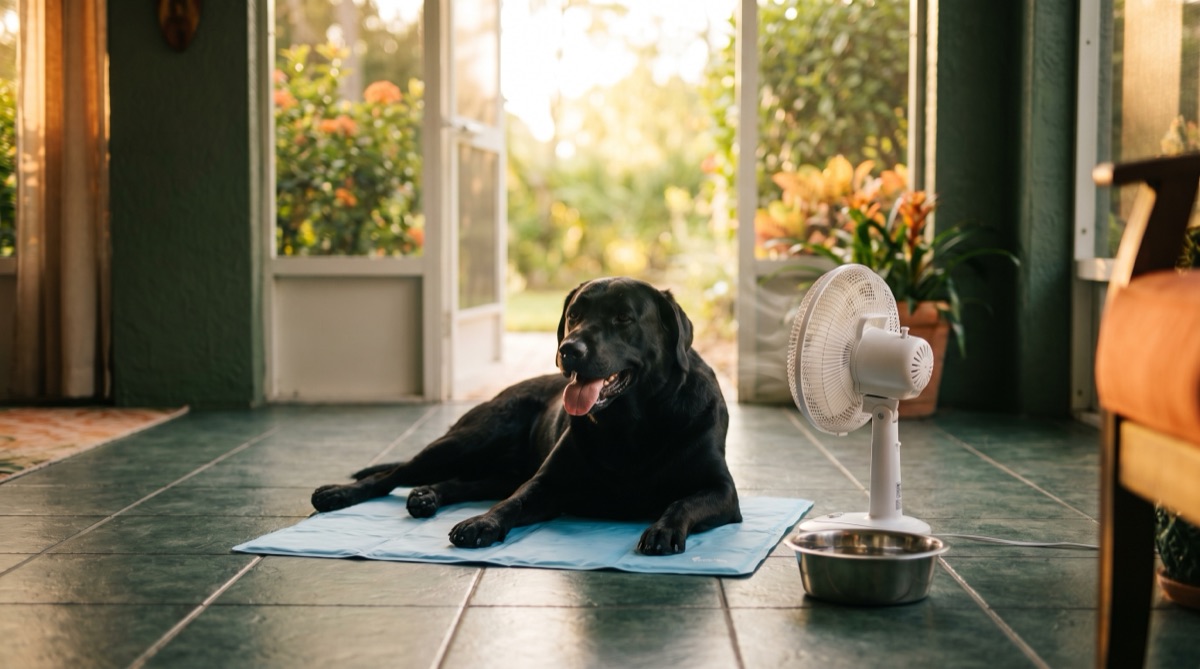
We're a Florida store, so heat isn't a seasonal footnote for us. From April through October it's the daily math of dog ownership: when to walk, where the shade is, how long a dark-coated dog can be out before he's done. The good news is that keeping a dog cool isn't complicated. It's a handful of habits locals learn fast, a little gear that genuinely helps, and knowing the warning signs by heart.
Everything below applies whether your version of brutal is Tampa in August, Phoenix in June, or a once-a-decade heat wave somewhere that doesn't believe in air conditioning. Heat is heat, and dogs handle it very differently than we do.
The heat rules locals live by
Start with the why, because it explains every rule that follows. Dogs barely sweat. They have a small number of sweat glands, mostly in their paw pads, and they shed almost all of their excess heat by panting. Panting is evaporative cooling, and evaporation works worse and worse as humidity climbs. That's why an 88-degree afternoon in Orlando is harder on a dog than a 95-degree afternoon in dry desert air, and why a dog can be in trouble at temperatures that feel merely unpleasant to you. Veterinary research has also found that exertion is the most common trigger for heat-related illness in dogs, which means the biggest lever you control is when and how hard your dog moves.
Walk at dawn, or well after dark. Early morning is the coolest the day will ever be. Evening is trickier than it looks, because pavement banks heat all afternoon and gives it back for hours after sunset. If you can only manage one real walk in deep summer, make it the morning one, and keep midday outings to quick potty breaks in the grass.
The seven-second pavement test. Before any walk on asphalt or concrete, press the back of your hand flat against the surface and hold it for seven seconds. If you can't, your dog can't either. The numbers behind this are sobering: asphalt in direct sun can run 40 to 60 degrees hotter than the air, so an 86-degree day can mean pavement around 135 degrees, and a 90-degree day can push it to 140, which is hot enough to burn paw pads in about a minute. Grass, dirt, and shaded sidewalks are your friends. So are booties, if your dog tolerates them.
The 150 rule. A guideline many veterinarians use: add the temperature in Fahrenheit to the humidity percentage. If the total is over 150, skip outdoor exercise. An 80-degree day at 80 percent humidity fails that test, which in Florida describes most of July. It feels conservative until you remember your dog is wearing a fur coat and cooling himself with his tongue.
Water everywhere, always. Offer water before you leave, carry it with you, and offer it again every 15 to 20 minutes on any outing. A dog who is panting hard is losing moisture with every breath. Thirst lags behind need, so offer rather than wait.
Gear that actually helps
Honesty first: no product makes a 95-degree afternoon safe for fetch. Gear buys you margin, comfort, and recovery time. It does not repeal the rules above. With that said, three categories earn their keep in a hot-weather household.
Cooling mats: how pressure-activated gel works
The classic cooling mat is filled with a pressure-activated gel that needs no water, no refrigerator, and no power cord. The gel absorbs body heat on contact, so it starts working the moment your dog lies down, and it keeps pulling heat away for a stretch of lounging before it needs a break. When your dog gets up, the gel releases that stored heat back into the room and recharges itself, usually in 15 to 20 minutes. Two practical notes: keep the mat out of direct sunlight, because it absorbs heat from the hottest thing touching it and you want that to be your dog, not a sunbeam. And put it where your dog already likes to flop, like tile by the back door or the crate pad spot. Our beds and comfort department carries our cooling mat alongside the rest of the nap gear, because in a Florida house the cool spot is part of the bed rotation.
Evaporative cooling vests
A cooling vest does for your dog what sweating does for you. You soak it in water, wring it out, and put it on. As the water evaporates, it carries heat away from your dog's body. The honest fine print: evaporation needs somewhere for the moisture to go, so vests perform best with airflow and drier air, think boat rides, breezy mornings, and shaded trails. On a still, soupy 90-percent-humidity afternoon, evaporation slows to a crawl and the vest does much less, so re-wet it often and don't treat it as a force field. Light colors help too, since they reflect sun instead of absorbing it. Vests live with the rest of our hot-weather and water gear in travel and adventure.
Shade and water on the go
The least glamorous gear is the most used: a water bottle with a built-in bowl, or a collapsible bowl that clips to the leash bag, so offering water never depends on finding a spigot. Add a clip-on shade or an umbrella for beach and boat days, because a dog who can retreat from direct sun cools dramatically faster than one who can't. Portable bowls and canteens are in bowls and feeding, and if your summers involve a boat, the whole deck setup is covered in travel and adventure.
The dogs that struggle most
Every dog can overheat, but some start the day with a handicap.
Flat-faced breeds. Bulldogs, French Bulldogs, Pugs, Boston Terriers, and other brachycephalic dogs have shortened airways, narrow nostrils, and long soft palates, which makes panting far less efficient. Published UK research on heat-related illness found flat-faced dogs face roughly double the risk of longer-muzzled dogs, with some individual breeds much higher. If you love a flat face, treat every threshold in this article as stricter: shorter outings, lower temperatures, more breaks, and a low bar for calling the day early.
Double-coated breeds. Huskies, Malamutes, German Shepherds, Golden Retrievers, and their double-coated cousins carry real insulation. Counterintuitively, that coat works in both directions: a well-maintained double coat traps a layer of air that buffers heat and blocks sun. The catch is the word maintained. A packed, unbrushed undercoat can't loft, so regular deshedding with a proper undercoat rake matters most in summer. You'll find those in grooming tools. What you should not do is shave the coat, and that one gets its own answer in the FAQ below.
Everyone else on the watch list. Seniors, overweight dogs, puppies, dogs with heart or breathing conditions, and dark-coated dogs all run out of margin sooner. When in doubt, treat your dog like a flat-faced senior in July: early walks, short sessions, lots of water.
Heat-stress warning signs and what to do
Know these calmly, the way you know where the fire extinguisher is. Early signs of heat stress: heavy, nonstop panting, thick ropey drool, gums that look bright red, and a dog who slows down, lags behind, or seeks shade on his own. More serious signs: wobbling or disorientation, vomiting or diarrhea, gums turning pale or purplish, and collapse. A dog's normal body temperature runs about 100.5 to 102.5 degrees, warmer than ours, so the gap between normal and dangerous is small.
If you see early signs, the plan is simple and immediate. Stop all activity. Move to shade or air conditioning. Pour cool tap water over the body, especially the belly, armpits, and paws. Use cool water, not ice water, which can constrict blood vessels at the skin and slow cooling. Don't drape soaked towels over the dog, since a wet blanket traps heat instead of releasing it; moving air over wet fur is what cools. Offer small amounts of water to drink. Then call your veterinarian, even if your dog seems to bounce back, because the serious effects of overheating aren't always visible from the outside. Veterinary guidance is to start cooling right away rather than waiting until you reach the clinic. We're a dog store, not a vet, and this is exactly the situation where the professional gets the call.
Indoor enrichment for the days you just don't go
Some days the math doesn't work and the right walk is no walk. The trick is remembering that mental work tires a dog out as effectively as a fair amount of physical work, and sniffing is the hardest mental work most dogs know. A snuffle mat loaded with your dog's regular kibble turns dinner into a 15-minute nose workout. Puzzle feeders do the same with more problem-solving. Ten minutes of training games, a round of hide-and-seek down the hallway, or simply rotating the toy bin so an old toy feels new again will buy you a calm evening on a day with zero outdoor minutes. The enrichment toys live in toys and fetch, and the training games have a whole department of their own in training and behavior.
Florida taught us most of this the humid way, and the same playbook holds anywhere the summer gets mean: move early, test the pavement, watch the dog instead of the thermometer, and keep the indoor game strong. If you're building out your own hot-weather kit, start with the cooling gear in travel and adventure and the cool-spot setup in beds and comfort. Your dog handles the napping. We'll handle the gear.
Not sure which gear fits your dog? Build a Pup Profile: five quick questions, and product pages across the store show what actually matches your pup. Build your Pup Profile