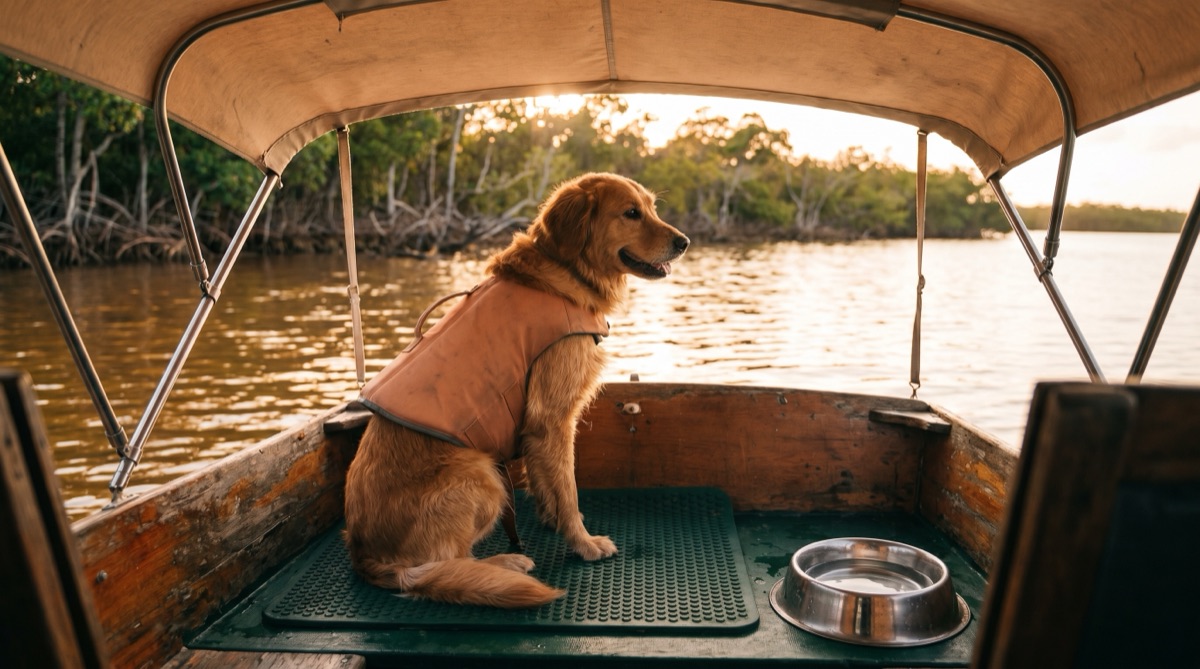
A boat day with your dog comes down to three non-negotiables: a properly fitted life jacket with a grab handle, more fresh water than you think you need, and a shaded spot where your dog can get out of the sun. The other nine items on this checklist handle footing, comfort, and cleanup. Pack all twelve and the day mostly takes care of itself.
We're a Florida store, so boat dogs aren't a niche for us. They're the whole point of our travel and adventure department. Here's the full packing list, plus the reasoning behind each item, so you can leave the dock with a relaxed dog and zero surprises.
The non-negotiables: life jacket, shade, fresh water
Start with the life jacket, even if your dog swims like a seal. Open water is not the neighborhood pool. Currents, boat wake, distance from shore, and plain old fatigue can wear out a strong swimmer, and a tired dog in the water has no ladder to grab. A flotation jacket buys time, keeps your dog's head up, and makes them easy to spot.
Fit is everything here. Sizing runs on girth, the measurement around the widest part of the ribcage just behind the front legs, not on weight alone. The BoatUS Foundation has run pool tests on popular dog flotation devices over the years, and their published takeaway is worth repeating: the handles, straps, buckles, and overall fit matter more than anything else on the jacket. Bright colors and reflective trim earn their keep too, because a dog's head is a small target to spot in chop. If you haven't sized one yet, our girth-first life jacket sizing guide walks you through the tape measure part, and our First Mate life jacket lives in the travel and adventure collection.
Shade and fresh water round out the big three. Boats are reflective ovens: sun comes off the water, the deck, and the console all at once, and most dogs won't remove themselves from the heat until they're already uncomfortable. Claim a shaded spot under the bimini or T-top before you leave the dock, and treat it as your dog's assigned seat.
Why a handle matters on board
The grab handle on a dog life jacket isn't decoration. It's the difference between hauling a wet, panicked dog over the gunwale by the armpits and lifting them in one clean motion. It also earns its keep at the dock, on the swim platform, and any time footing gets dicey. Before the first trip, check that you can fit your hand through the handle comfortably and lift your dog's weight with it. If the jacket shifts or sags when you lift, tighten the straps and test again.
Deck comfort and footing
Traction
Fiberglass gets slick the moment it gets wet, and dogs don't have boat shoes. A dog that slides every time the boat turns learns to dread the boat, and a scrambling dog near the transom is a problem you don't want. A non-slip traction mat gives your dog one reliable patch of grip to stand on, and most dogs figure out within a trip or two that the mat is home base. Ours is called the Deck Hand, and it lives with the rest of the boat gear. A rubber-backed bath mat works in a pinch; it just won't drain or rinse as well.
Heat on deck surfaces
Paw pads burn, and deck surfaces get hotter than the air by a wide margin. Published guidance on pavement applies just as well to a boat: dark surfaces can climb past 125 degrees Fahrenheit on days when the air is only in the upper 70s, and at those surface temperatures pads can burn in about a minute. Metal hardware, dark non-skid, and vinyl seats heat up fastest. Use the seven-second test before your dog walks anywhere: press the back of your hand to the surface and hold it for seven seconds. If you can't, it's too hot for paws. The traction mat solves most of this, because it doubles as a heat barrier between pads and deck.
Water and sun
Fresh water vs salt water drinking
This is the one rule that surprises new boat-dog owners: your dog will drink whatever water is closest, and on a boat that's usually the wrong kind. Salt water pulls moisture out of the body instead of putting it in, and a dog that swallows enough of it, whether by drinking or by gulping during fetch, can develop salt toxicity. Veterinary sources describe the early signs as vomiting, diarrhea, and unusual sluggishness after a water day. If you see those after a saltwater outing, call your vet.
The fix is boring and effective: offer fresh water early and often, before your dog is thirsty enough to improvise. A common veterinary baseline is roughly one ounce of water per pound of body weight per day, and a hot day of swimming and excitement pushes that up. For a 60-pound dog, that means packing a couple of liters for the dog alone. A spill-resistant travel bowl matters just as much as the water itself, because an open bowl on a moving deck is a puddle within minutes. Our bowls and feeding department has a no-slosh travel bowl built for exactly this.
Cooling options
Dogs cool off mainly by panting, which works poorly in humid air over open water. Help them out. Shade is the first tool, fresh water the second, and evaporative gear the third: a cooling vest you soak, wring, and put on works like sweat your dog doesn't have. Sun protection belongs in this section too. Short-coated and pink-skinned dogs, think Dalmatians, Boxers, Bull Terriers, and many pit-bull-type dogs, can sunburn on the nose bridge, ear tips, and belly. If that's your dog, pack a dog-specific sunscreen, and skip human formulas that contain zinc oxide or PABA, which are problems if licked. For the full hot-weather playbook, including the walk-timing rules Florida locals live by, see our guide to keeping dogs cool in serious heat.
The 12-item printable checklist
Here's the whole kit in one list. Screenshot it, print it, or tape it inside the dock box.
- Life jacket, fitted and tested. Girth-first sizing, grab handle you've actually lifted with, buckles checked.
- Fresh water. Roughly an ounce per pound of body weight as a daily baseline, packed up from there for heat and swimming.
- Spill-resistant water bowl. Open bowls don't survive wake.
- A shaded spot. Bimini, T-top, or cabin. Decide where before you leave.
- Non-slip traction mat. Grip for wet fiberglass, heat barrier for hot deck.
- Leash. For the dock, the ramp, and the fuel stop. Not for wearing underway, where a dragging leash is a snag hazard.
- Collar with ID tag. Current phone number, readable engraving. Boats end up at marinas, and marinas have exits.
- Dog-specific sunscreen. For short coats and pink skin. No zinc oxide, no PABA.
- Quick-dry towel. One for the dog, and honestly one for the seat your dog will shake next to.
- Waste bags. A dog that's excited and hydrated is a dog that will need a moment. Plan the potty stop.
- A floating fetch toy. High-visibility, genuinely buoyant, easy to spot in chop. Fetch happens; pick gear that survives it.
- A familiar mat or blanket. A scent-of-home rest spot tells your dog where to settle when the engine is running.
If you'd rather grab the core of this list in one go, the Captain's Package in our travel and adventure collection bundles the life jacket with a floating long line and a quick-dry leash. It's the kit we'd hand a brand-new boat dog's human.
First boat trip tips
The gear gets you ready. The first trip itself goes better with a little stagecraft:
- Visit before you cruise. Let your dog explore the boat at the dock or on the trailer, sniff everything, and get treats for calm behavior. Boating organizations and trainers consistently recommend starting the engine while still tied up, so the noise becomes old news before the boat ever moves.
- Keep trip one short. Twenty or thirty calm minutes beats three ambitious hours. End the trip while your dog is still having a good time, and stretch the next one.
- Practice the boarding ramp. Getting on and off is the scariest part for most dogs. Rehearse it at the dock with the leash and the life jacket handle until it's routine.
- Agree on an overboard plan. Before you leave, decide who cuts the engine, who points and keeps eyes on the dog, and who lifts. The engine comes off first, every time, before anyone goes near the dog in the water.
- Watch for queasy signals. Lip licking, drooling, yawning, and whining can mean a seasick dog. Slow down, find calmer water, and shorten the day if you see them.
That's the whole system: twelve items in the bag, one calm first trip, and a dog that starts spinning circles every time you pick up the boat keys. When you're ready to build the kit, the travel and adventure collection is where our boat gear lives, life jacket first.
Not sure which gear fits your dog? Build a Pup Profile: five quick questions, and product pages across the store show what actually matches your pup. Build your Pup Profile